
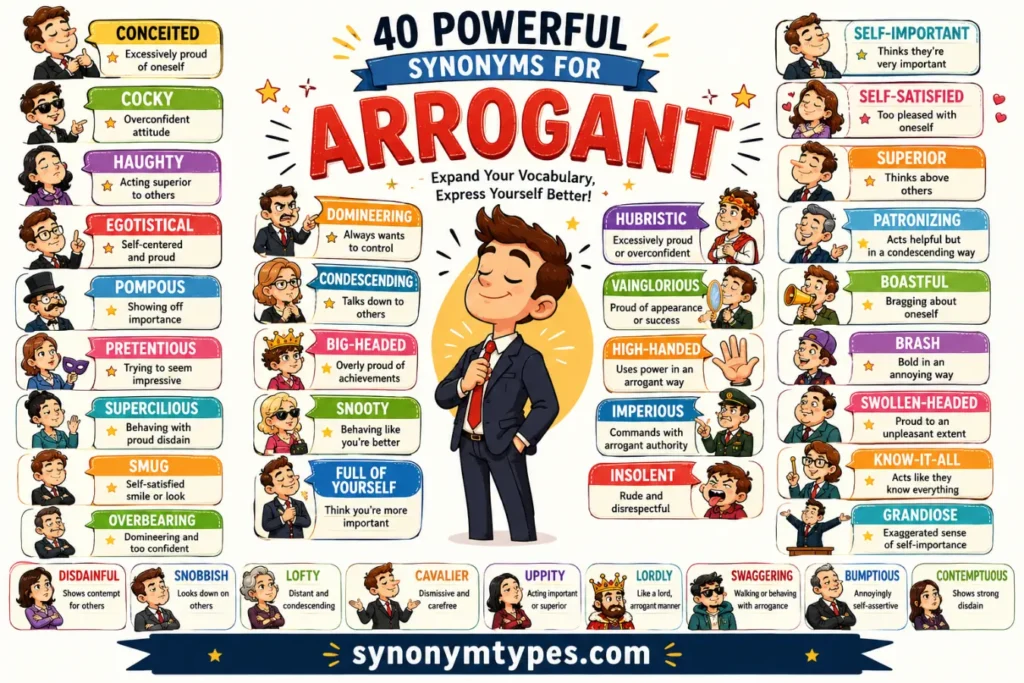
The right hubris synonym can turn a simple description of pride into a powerful, precise expression of arrogance and superiority. A person who becomes overly impressed with their own success may start ignoring advice, dismissing criticism, and treating others as inferior. Finding the right hubris synonym helps describe this kind of excessive pride more precisely. While arrogance is one of the closest alternatives, other words can emphasize conceit, superiority, overconfidence, or an inflated sense of importance.
For students, writers, and English learners, knowing different hubris synonyms makes descriptions more accurate and expressive. However, not every alternative has exactly the same meaning or tone. Therefore, this guide explores 40 useful alternatives to hubris, including their meanings and examples. In addition, you will find pronunciation help, antonyms, formal and informal alternatives, a quick-reference table, usage guidance, and answers to common questions.
What Does “Hubris Synonym” Mean?
A hubris synonym is a word that expresses excessive pride, arrogance, self-importance, or an exaggerated belief in one’s own abilities or superiority.
For example: Arrogance is a common hubris synonym because both words can describe an excessive sense of superiority.
Pronunciation of “Hubris”
Phonetic Spelling: HYOO-briss
IPA Format: /ˈhjuːbrɪs/
Simple Breakdown: HYOO + briss
The first syllable sounds like “hue,” while the second sounds like “briss.” Therefore, saying HYOO-briss slowly can make the pronunciation easier.
Syllables of “Hubris”
Syllable breakdown: hu-bris
Number of syllables: 2
Pronounce it slowly as HYOO-briss, with the strongest stress on the first syllable.
Top 5 Synonyms for Hubris
1. Arrogance
2. Conceit
3. Haughtiness
4. Egotism
5. Overconfidence
Top 5 Antonyms of Hubris
1. Humility
2. Modesty
3. Humbleness
4. Meekness
5. Selflessness
Hubris Synonyms by Category
Formal Hubris Synonyms
Arrogance, haughtiness, grandiosity, presumption, egotism, imperiousness, vainglory, self-aggrandizement
Informal Hubris Synonyms
Cockiness, smugness, big-headedness, swagger, boastfulness, conceit, overconfidence, self-importance
Strong Hubris Synonyms
Haughtiness, arrogance, imperiousness, superciliousness, insolence, grandiosity, pomposity, self-aggrandizement
| Formal | Informal | Strong |
|---|---|---|
| Arrogance | Cockiness | Haughtiness |
| Grandiosity | Smugness | Imperiousness |
| Presumption | Swagger | Insolence |
| Egotism | Big-headedness | Superciliousness |
| Vainglory | Boastfulness | Pomposity |
| Self-aggrandizement | Overconfidence | Arrogance |
40 Best Hubris Synonyms With Meanings and Examples
1. Arrogance
Meaning
Arrogance is an exaggerated sense of one’s own importance, abilities, or superiority over others.
Examples
- His arrogance prevented him from accepting useful advice.
- However, his confidence gradually became arrogance.
2. Conceit
Meaning
Conceit is excessive pride in one’s abilities, appearance, qualities, or achievements.
Examples
- Her conceit made it difficult for her to accept criticism.
- The character’s conceit becomes obvious throughout the novel.
3. Haughtiness
Meaning
Haughtiness describes an openly superior attitude that treats other people as less important.
Examples
- His haughtiness offended several members of the committee.
- Meanwhile, her haughtiness made cooperation difficult.
4. Egotism
Meaning
Egotism is excessive self-focus combined with an exaggerated belief in one’s own importance.
Examples
- His egotism dominated every discussion.
- The author uses the character’s egotism to reveal his weakness.
5. Overconfidence
Meaning
Overconfidence is excessive belief in one’s abilities, knowledge, or likelihood of success.
Examples
- Her overconfidence caused her to underestimate the competition.
- Therefore, overconfidence became a major reason for the failure.
6. Self-importance
Meaning
Self-importance is an inflated belief that one’s opinions, position, or needs are especially significant.
Examples
- His sense of self-importance annoyed his coworkers.
- The speech revealed considerable self-importance.
7. Grandiosity
Meaning
Grandiosity is an exaggerated sense of personal importance, power, talent, or status.
Examples
- His grandiosity made realistic planning almost impossible.
- The character’s grandiosity increased after his promotion.
8. Presumption
Meaning
Presumption is an excessively confident assumption of authority, importance, or entitlement.
Examples
- His presumption surprised everyone in the room.
- The manager criticized such presumption as inappropriate.
9. Vainglory
Meaning
Vainglory is excessive pride in one’s achievements, reputation, appearance, or abilities.
Examples
- His pursuit of vainglory damaged his relationships.
- The poem warns readers against the dangers of vainglory.
10. Pomposity
Meaning
Pomposity is an overly self-important manner of speaking or behaving.
Examples
- His pomposity made a simple presentation unnecessarily complicated.
- The writer humorously exposes the character’s pomposity.
11. Pretentiousness
Meaning
Pretentiousness is an attempt to appear more important, intelligent, sophisticated, or impressive than one really is.
Examples
- His pretentiousness quickly became obvious.
- However, the audience was not impressed by her pretentiousness.
12. Smugness
Meaning
Smugness is excessive satisfaction with oneself, especially when accompanied by a sense of superiority.
Examples
- His smugness disappeared after the final results were announced.
- The expression on her face suggested complete smugness.
13. Cockiness
Meaning
Cockiness is an informal term for excessive confidence that can appear arrogant or irritating.
Examples
- His cockiness irritated the other players.
- After the defeat, his cockiness quickly disappeared.
14. Big-headedness
Meaning
Big-headedness is an informal expression for an exaggerated opinion of one’s own importance or ability.
Examples
- Fame sometimes leads to big-headedness.
- His friends warned him not to become big-headed.
15. Swagger
Meaning
Swagger is a confident and sometimes arrogant manner of walking, speaking, or behaving.
Examples
- He entered the room with noticeable swagger.
- Meanwhile, his swagger disappeared after the criticism.
16. Boastfulness
Meaning
Boastfulness is a tendency to talk excessively and proudly about one’s achievements or abilities.
Examples
- His boastfulness made the conversation uncomfortable.
- The character’s boastfulness revealed his insecurity.
17. Imperiousness
Meaning
Imperiousness is an arrogant manner that expects others to obey or submit.
Examples
- Her imperiousness intimidated the junior employees.
- The leader’s imperiousness created resentment among the staff.
18. Insolence
Meaning
Insolence is boldly disrespectful behavior that often reflects excessive confidence or entitlement.
Examples
- The student’s insolence surprised the teacher.
- His insolence eventually resulted in disciplinary action.
19. Superiority
Meaning
Superiority is the belief that one is better, more capable, or more important than other people.
Examples
- His attitude communicated a strong sense of superiority.
- Therefore, his superiority alienated his colleagues.
20. Self-conceit
Meaning
Self-conceit is an exaggerated opinion of one’s own qualities, abilities, or importance.
Examples
- His self-conceit prevented him from learning from others.
- The story presents self-conceit as a destructive weakness.
21. Self-admiration
Meaning
Self-admiration is excessive admiration or satisfaction directed toward oneself.
Examples
- His constant self-admiration became tiresome.
- The character’s self-admiration concealed deeper insecurity.
22. Narcissism
Meaning
Narcissism involves excessive self-focus, self-admiration, and an exaggerated sense of importance.
Examples
- His narcissism affected the entire workplace.
- However, narcissism is not identical to ordinary confidence.
23. Self-satisfaction
Meaning
Self-satisfaction is excessive contentment with oneself that can prevent recognition of weaknesses.
Examples
- Their self-satisfaction prevented further improvement.
- The coach warned against self-satisfaction after the victory.
24. Disdain
Meaning
Disdain is a feeling that someone or something is unworthy of respect or consideration.
Examples
- He treated the suggestion with obvious disdain.
- Her disdain for opposing opinions was noticeable.
25. Contempt
Meaning
Contempt is a strong feeling that someone or something is beneath one’s respect or consideration.
Examples
- His contempt for his opponents was unmistakable.
- The speech expressed open contempt for criticism.
26. Disrespect
Meaning
Disrespect is a lack of proper regard for another person or group.
Examples
- His disrespect toward the staff caused conflict.
- The manager refused to tolerate such disrespect.
27. Dominance
Meaning
Dominance is a position of control or superiority that can accompany an inflated sense of power.
Examples
- His desire for dominance affected the team’s decisions.
- The character constantly sought dominance over others.
28. Tyranny
Meaning
Tyranny is oppressive use of power, particularly when authority becomes unchecked and abusive.
Examples
- His unchecked pride eventually developed into tyranny.
- The novel explores how ambition can lead to tyranny.
29. Dictatorialness
Meaning
Dictatorialness describes an excessively controlling attitude in which someone expects unquestioning obedience.
Examples
- His dictatorialness discouraged employees from speaking openly.
- The leader’s dictatorialness created tension throughout the organization.
30. Superciliousness
Meaning
Superciliousness is an arrogant attitude that treats others as intellectually or socially inferior.
Examples
- His superciliousness was obvious during the debate.
- The character speaks with deliberate superciliousness.
31. Overbearingness
Meaning
Overbearingness describes behavior that is excessively forceful, controlling, or domineering.
Examples
- Her overbearingness made group discussions uncomfortable.
- His overbearingness eventually pushed people away.
32. Loftiness
Meaning
Loftiness can describe an elevated and distant attitude that appears superior or arrogant.
Examples
- His loftiness made ordinary conversations difficult.
- The character’s loftiness concealed his fear of failure.
33. Self-glorification
Meaning
Self-glorification is the act of presenting oneself as exceptionally important, admirable, or successful.
Examples
- The speech sounded more like self-glorification than leadership.
- His constant self-glorification irritated the audience.
34. Self-exaltation
Meaning
Self-exaltation is the act of elevating oneself above others in status, importance, or achievement.
Examples
- The article criticizes political self-exaltation.
- His self-exaltation weakened the credibility of his message.
35. Ostentation
Meaning
Ostentation is an excessive display of wealth, success, knowledge, or importance intended to impress others.
Examples
- The mansion’s ostentation attracted considerable attention.
- His ostentation made the celebration seem excessive.
36. Braggadocio
Meaning
Braggadocio is boastful or arrogant behavior, especially when someone exaggerates their abilities.
Examples
- His braggadocio impressed nobody at the meeting.
- The character hides his insecurity behind braggadocio.
37. Self-aggrandizement
Meaning
Self-aggrandizement is an attempt to make oneself appear more powerful, important, or impressive.
Examples
- The announcement seemed designed for self-aggrandizement.
- His constant self-aggrandizement damaged his public image.
38. Self-superiority
Meaning
Self-superiority is an exaggerated belief that one’s qualities or abilities are greater than those of others.
Examples
- His behavior reflected a strong sense of self-superiority.
- The essay examines how self-superiority can damage relationships.
39. Arrogant self-regard
Meaning
Arrogant self-regard describes an excessive and inflated opinion of one’s own value or abilities.
Examples
- His arrogant self-regard prevented him from recognizing his mistakes.
- The character’s arrogant self-regard eventually caused his downfall.
40. Overweeningness
Meaning
Overweeningness is excessive pride or confidence that makes someone believe they are more important or capable than others.
Examples
- His overweeningness prevented him from listening to experienced advisers.
- The story portrays overweeningness as the cause of his eventual failure.
When to Use Each Hubris Synonym
Grandiosity
Use in: academic writing, literary analysis, or serious descriptions
Example: The novel presents his grandiosity as the source of his downfall.
Vainglory
Use in: literature, historical writing, or philosophical discussions
Example: The poem warns that vainglory can destroy genuine achievement.
Cockiness
Use in: everyday conversations, sports, or casual writing
Example: His cockiness annoyed the other players.
Pomposity
Use in: formal criticism, speeches, or character descriptions
Example: The speaker’s pomposity distracted from his main argument.
Braggadocio
Use in: creative writing and colorful character descriptions
Example: The soldier’s braggadocio amused his companions.
Superciliousness
Use in: advanced literary or formal descriptions
Example: Her superciliousness made every conversation uncomfortable.
Self-aggrandizement
Use in: journalism, criticism, and formal analysis
Example: The announcement appeared to be an act of self-aggrandizement.
Ostentation
Use in: describing wealth, possessions, or impressive displays
Example: The palace was designed with remarkable ostentation.
Is Arrogance a Hubris Synonym?
Yes, arrogance is one of the closest and most common hubris synonyms. Both words describe an exaggerated sense of superiority or self-importance. However, hubris often suggests that excessive pride goes beyond ordinary arrogance and contributes to poor judgment or serious mistakes.
For example, a successful manager may become arrogant by dismissing coworkers. If that attitude becomes extreme and causes the manager to make reckless decisions, the behavior may be described as hubris.
What Is Another Word for Hubris?
Another word for hubris is arrogance, but the best choice depends on the intended meaning. For example, conceit emphasizes excessive pride in oneself, while haughtiness emphasizes a superior attitude toward others.
Similarly, grandiosity works well when someone has an exaggerated belief in their importance or power. Therefore, writers should select an alternative according to the exact context.
Hubris Synonym for Academic and Essay Writing
For academic writing, strong alternatives include arrogance, egotism, grandiosity, haughtiness, presumption, self-importance, vainglory, and self-aggrandizement. These words can make an argument more precise while reducing unnecessary repetition.
For example, instead of writing, “The ruler showed hubris,” an essay could say, “The ruler displayed extreme self-importance and refused to consider opposing views.” This version explains the behavior more specifically.
Hubris Synonym vs. Arrogance
Although hubris and arrogance are closely related, they are not always interchangeable. Arrogance generally means an exaggerated sense of superiority, whereas hubris often implies excessive pride that leads to overconfidence, bad decisions, or eventual consequences.
As a result, arrogance is usually the better everyday alternative, while hubris can be especially effective in literary, historical, and analytical contexts.
The Final Talk
Choose the right hubris synonym, and let your words reveal exactly how far excessive pride can go. Finding the right hubris synonym allows you to describe excessive pride with greater precision. Although arrogance is the most common alternative, words such as conceit, haughtiness, egotism, grandiosity, overconfidence, vainglory, and self-aggrandizement communicate different shades of meaning.
Moreover, context matters when selecting an alternative. A student may use grandiosity in an essay, while a novelist may prefer swagger or braggadocio for a vivid character description. Therefore, understanding these distinctions can improve vocabulary, academic writing, creative writing, and everyday communication. Keep this list of hubris synonyms handy whenever you need a more precise way to describe excessive pride or an inflated sense of superiority.
FAQs
The best synonyms for hubris include arrogance, conceit, haughtiness, egotism, overconfidence, grandiosity, self-importance, and vainglory. However, arrogance is generally the closest everyday alternative.
Another word for hubris is arrogance. Depending on the context, you can also use conceit, haughtiness, egotism, grandiosity, or self-importance.
Yes. Arrogance is a common synonym for hubris, although hubris often suggests that excessive pride has become extreme enough to cause poor judgment or serious consequences.
No. Pride can be positive when it reflects healthy satisfaction in an achievement. Hubris, on the other hand, specifically describes excessive or unhealthy pride and self-confidence.
The opposite of hubris is generally humility or modesty. Other useful antonyms include humbleness, meekness, and selflessness.
Discover More to Learn
Forest Synonyms: 40 Words, Alternatives, and Descriptive Terms
Favorite Synonyms: 40 Similar Words and Alternatives

Pingback: Another Word for Productive: 40 Similar Words With Meanings
Pingback: Another Word for Honor: 40 Powerful Synonyms
Pingback: Artsy Synonym: 40 Similar Words, Meanings and Examples
Pingback: Another Word for Aggressive: 40 Powerful Synonyms
Pingback: Nickname Synonym: 40 Alternative Names to Use
Pingback: Oblivious Synonym: 40 Similar Words With Meanings
Pingback: Other Words for Cool: 40 Powerful Synonyms and Examples