A strong vocabulary makes it easier to describe who someone is, how they behave, and what qualities they value. When you need synonyms for Character, Personality & Virtue Words, choosing the right term can make your writing more precise, natural, and engaging. Character words often describe deeper moral qualities, while personality words may describe someone’s temperament, social style, or distinctive presence. Virtue words, meanwhile, usually emphasize qualities considered morally good or desirable.
This guide gives you 40 useful words for describing character, personality, and virtue, from everyday choices such as honesty and kindness to more formal terms such as probity and rectitude. You will also find meanings, examples, categories, antonyms, pronunciation information, and a quick reference table. In addition, related vocabulary such as fair, humble, authentic, impressive, graceful, prudent, and iconic can help you make more specific descriptions.
What Does “Character, Personality & Virtue Words” Mean?
Character, personality, and virtue words are terms used to describe a person’s qualities, behavior, temperament, values, or moral standards. Although these categories overlap, character often emphasizes moral qualities, personality focuses on distinctive traits, and virtue highlights desirable qualities or ethical excellence.
For example: Her honesty, calm personality, and strong character made her a trusted leader.
Pronunciation of “Character, Personality & Virtue”
Because this is a phrase rather than a single vocabulary word, each major term has its own pronunciation:
Character
Phonetic spelling: KAR-ik-ter
IPA: /ˈkerəktər/
Simple breakdown: CHAR-ac-ter
Personality
Phonetic spelling: pur-suh-NAL-uh-tee
IPA: /ˌpɜːrsəˈnæləti/
Simple breakdown: per-son-AL-i-ty
Virtue
Phonetic spelling: VUR-choo
IPA: /ˈvɜːrtʃuː/
Simple breakdown: VIR-tue
Syllables of “Character, Personality & Virtue”
The three key words have different syllable patterns:
Character: char-ac-ter — 3 syllables
Personality: per-son-al-i-ty — 5 syllables
Virtue: vir-tue — 2 syllables
When practicing them slowly, say each syllable separately first. Then, gradually combine the sounds until the word feels natural in normal conversation.
Top 5 Character, Personality & Virtue Synonyms
- Traits
- Qualities
- Characteristics
- Attributes
- Disposition
These are among the most useful general alternatives when talking about the qualities that distinguish a person. Merriam-Webster and other thesaurus resources similarly group terms such as character, disposition, temperament, traits, qualities, and attributes around personality and individual qualities.
Top 5 Antonyms of Character, Personality & Virtue Words
- Flaws
- Defects
- Weaknesses
- Vices
- Shortcomings
These opposites are useful when your writing needs to emphasize undesirable qualities, moral failings, or personal weaknesses.
Character, Personality & Virtue Synonyms by Category
The best word depends heavily on context. A formal report may require a different term from a casual conversation, while creative writing often benefits from stronger and more vivid vocabulary.
Formal Character, Personality & Virtue Synonyms
Integrity, probity, rectitude, righteousness, disposition, temperament, individuality, characteristics
Informal Character, Personality & Virtue Synonyms
Nature, personality, vibe, manner, style, attitude, charm, spirit
Strong Character, Personality & Virtue Synonyms
Fortitude, courage, integrity, trustworthiness, authenticity, compassion, prudence, generosity
Quick Comparison Table
| Formal | Informal | Strong |
|---|---|---|
| Integrity | Nature | Fortitude |
| Probity | Personality | Courage |
| Rectitude | Vibe | Authenticity |
| Disposition | Manner | Compassion |
| Temperament | Charm | Trustworthiness |
| Righteousness | Spirit | Generosity |
40 Best Character, Personality & Virtue Synonyms With Meanings and Examples
The following list focuses on useful words that describe people and their qualities. Some are close synonyms, while others represent specific aspects of character, personality, or virtue. This distinction matters because words that seem interchangeable can carry different shades of meaning.
1. Traits
Meaning
Traits are distinguishing qualities or patterns of behavior that describe a person.
Examples
- Patience and honesty are valuable character traits.
- Her creative traits make her an excellent designer.
2. Qualities
Meaning
Qualities are characteristics or features that describe the nature of a person.
Examples
- Kindness is one of his best qualities.
- The job requires qualities such as patience and reliability.
3. Characteristics
Meaning
Characteristics are distinctive features or qualities that identify a person.
Examples
- Confidence and curiosity are common characteristics of successful learners.
- Her strongest characteristics include patience and determination.
4. Attributes
Meaning
Attributes are particular qualities or features associated with someone.
Examples
- Leadership is an important attribute in this position.
- Honesty is one of her most respected attributes.
5. Disposition
Meaning
Disposition refers to a person’s usual mood, attitude, or tendency to behave in a particular way.
Examples
- His cheerful disposition made everyone feel welcome.
- She has a calm disposition even under pressure.
6. Temperament
Meaning
Temperament describes a person’s characteristic emotional nature and reactions.
Examples
- Her patient temperament helps her work with children.
- His energetic temperament suits the demanding role.
7. Nature
Meaning
Nature refers to the basic qualities and tendencies that form someone’s character.
Examples
- Her generous nature makes her easy to trust.
- His curious nature encourages him to keep learning.
8. Individuality
Meaning
Individuality is the combination of qualities that makes someone distinct from others.
Examples
- The designer’s individuality appears in every collection.
- She never hides her individuality when expressing her ideas.
9. Identity
Meaning
Identity is the sense of who a person is and the qualities that distinguish them.
Examples
- Writing helped him develop a stronger sense of identity.
- Her cultural experiences became an important part of her identity.
10. Psyche
Meaning
Psyche refers to the mind and emotional nature of a person.
Examples
- The novel explores the troubled psyche of its main character.
- Understanding the human psyche can improve character development.
11. Persona
Meaning
Persona is the public image or personality that someone presents to others.
Examples
- The actor created a confident persona for the role.
- His professional persona is more serious than his private personality.
12. Demeanor
Meaning
Demeanor is the outward way a person appears to behave, especially through attitude and manner.
Examples
- Her calm demeanor reassured the nervous students.
- Despite the criticism, he maintained a professional demeanor.
13. Manner
Meaning
Manner refers to the way someone behaves, speaks, or interacts with others.
Examples
- His polite manner impressed the guests.
- She has a warm and welcoming manner.
14. Ethos
Meaning
Ethos is the set of values, beliefs, or guiding principles that shape a person or group.
Examples
- The organization’s ethos emphasizes fairness and respect.
- Her personal ethos is built around honesty and service.
15. Integrity
Meaning
Integrity is the quality of being honest and guided by strong moral principles.
Examples
- The manager earned everyone’s respect through her integrity.
- He demonstrated integrity by admitting his mistake.
If you need more vocabulary specifically related to this quality, an article on integrity synonyms can provide more precise alternatives for formal and professional writing.
16. Morality
Meaning
Morality refers to principles concerning right and wrong behavior.
Examples
- The story raises important questions about morality.
- His decisions are strongly influenced by his sense of morality.
17. Honor
Meaning
Honor is a strong sense of ethical behavior, respect, or personal integrity.
Examples
- She accepted the responsibility as a matter of honor.
- He defended his family with courage and honor.
18. Decency
Meaning
Decency is behavior that conforms to accepted standards of respect, fairness, and good conduct.
Examples
- Everyone deserves to be treated with basic decency.
- His simple act of decency changed the situation.
19. Goodness
Meaning
Goodness is the quality of being morally good, kind, or beneficial toward others.
Examples
- Her goodness was obvious in the way she helped strangers.
- The character represents hope and human goodness.
20. Honesty
Meaning
Honesty is the quality of being truthful and sincere rather than deceptive.
Examples
- I appreciate your honesty about the situation.
- Her honesty helped resolve the disagreement quickly.
21. Probity
Meaning
Probity is strong moral integrity and honesty, especially in formal or professional contexts.
Examples
- The auditor was respected for his financial probity.
- Her professional probity was never questioned.
22. Rectitude
Meaning
Rectitude means morally correct behavior and strong adherence to ethical principles.
Examples
- The judge was admired for her moral rectitude.
- He approached every decision with intellectual and moral rectitude.
23. Righteousness
Meaning
Righteousness refers to morally correct or virtuous conduct.
Examples
- The story contrasts corruption with righteousness.
- He believed righteousness required action, not merely words.
24. Prudence
Meaning
Prudence is the quality of making careful and sensible decisions after considering possible consequences.
Examples
- Financial prudence helped the family avoid unnecessary debt.
- She showed prudence by reviewing the contract carefully.
For more context-specific vocabulary, prudent synonyms can help you choose between words such as wise, sensible, cautious, and judicious.
25. Humility
Meaning
Humility is the quality of being modest and not considering yourself more important than others.
Examples
- Her humility remained intact despite her success.
- He accepted the award with genuine humility.
If you are looking for alternatives with slightly different shades of meaning, humble synonyms can be useful for describing modest and unassuming people.
26. Fairness
Meaning
Fairness is the quality of treating people reasonably, equally, and without unjust bias.
Examples
- The teacher was praised for her fairness.
- Everyone expected the manager to act with fairness.
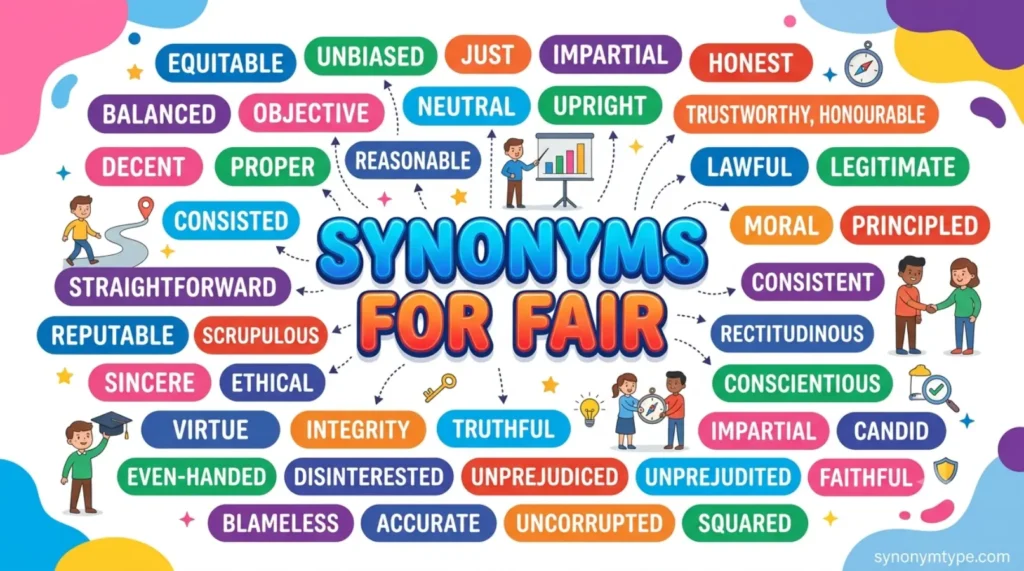
For more precise choices in different contexts, explore fair synonyms such as just, impartial, equitable, and reasonable.
27. Grace
Meaning
Grace can describe elegance, kindness, dignity, or a composed way of handling situations.
Examples
- She accepted the criticism with grace.
- His grace under pressure impressed the entire team.
The broader topic of grace synonyms is especially useful when you want to distinguish elegance from kindness, courtesy, or dignity.
28. Authenticity
Meaning
Authenticity is the quality of being genuine, sincere, and true to one’s real identity or values.
Examples
- Her authenticity made the audience trust her.
- The writer’s authenticity gives the story emotional power.
For more options, authentic synonyms can help you choose among genuine, sincere, real, original, and legitimate depending on context.
29. Charisma
Meaning
Charisma is a compelling personal quality that naturally attracts or influences other people.
Examples
- Her charisma made her an effective public speaker.
- The actor’s charisma was obvious from his first appearance.
30. Charm
Meaning
Charm is an appealing quality that makes someone pleasant, attractive, or engaging.
Examples
- His quiet charm made him popular with coworkers.
- She used her charm to make the guests feel comfortable.
31. Courage
Meaning
Courage is the ability to face fear, difficulty, or danger with determination.
Examples
- It took courage to speak honestly about the problem.
- Her courage inspired everyone around her.
32. Fortitude
Meaning
Fortitude is mental and emotional strength when facing hardship or adversity.
Examples
- She showed remarkable fortitude during the difficult period.
- His fortitude helped him continue despite repeated setbacks.
33. Generosity
Meaning
Generosity is the willingness to give time, money, attention, or help freely to others.
Examples
- His generosity helped the community recover.
- She is known for her generosity toward younger colleagues.
34. Compassion
Meaning
Compassion is sympathetic concern for another person’s suffering combined with a desire to help.
Examples
- The nurse treated every patient with compassion.
- Her compassion made her an excellent counselor.
35. Trustworthiness
Meaning
Trustworthiness is the quality of being reliable, honest, and deserving of confidence.
Examples
- His trustworthiness made him a natural choice for the position.
- The company built its reputation on reliability and trustworthiness.
36. Artsy
Meaning
Artsy describes someone or something associated with artistic, creative, unconventional, or aesthetic interests.
Examples
- Her artsy personality is reflected in her colorful workspace.
- The café has an artsy atmosphere filled with handmade decorations.
If you want alternatives for creative or artistic descriptions, artsy synonyms can give you options such as artistic, creative, bohemian, imaginative, and aesthetic.
37. Impressive
Meaning
Impressive describes someone or something that produces admiration because of notable quality, ability, or achievement.
Examples
- Her impressive character made her an excellent leader.
- He gave an impressive performance at the competition.
For stronger descriptive vocabulary, impressive synonyms can help you choose words such as remarkable, outstanding, extraordinary, striking, or exceptional.
38. Interesting
Meaning
Interesting describes something that attracts attention because it is unusual, engaging, informative, or thought-provoking.
Examples
- Her interesting personality made conversations enjoyable.
- The author created an interesting character with conflicting values.
When you want more precise wording, interesting synonyms can help you select alternatives such as fascinating, engaging, intriguing, compelling, or absorbing.
39. Extraordinary
Meaning
Extraordinary describes someone or something unusually remarkable, exceptional, or far beyond what is ordinary.
Examples
- Her extraordinary courage inspired the entire community.
- He has an extraordinary ability to understand people.
The related topic of extraordinary synonyms is useful when you want to distinguish remarkable, exceptional, phenomenal, unusual, and exceptional in your writing.
40. Lighthearted
Meaning
Lighthearted describes a cheerful, carefree, or playful attitude that lacks unnecessary seriousness.
Examples
- His lighthearted personality made difficult meetings more enjoyable.
- The author added a lighthearted character to balance the serious story.
For casual and creative descriptions, lighthearted synonyms such as cheerful, playful, carefree, upbeat, and jovial can add variety.
When to Use Character, Personality & Virtue Synonyms
The right synonym depends on what you want the reader to notice. Therefore, avoid replacing a word simply because it appears in a thesaurus.
Integrity
Use in: professional writing and ethical discussions
Example: The organization values integrity in every decision.
Charisma
Use in: biographies and descriptions of influential people
Example: Her charisma helped her connect with the audience.
Prudence
Use in: financial, academic, or formal writing
Example: The board acted with prudence before approving the proposal.
Humility
Use in: personal descriptions and character analysis
Example: Despite his success, he showed remarkable humility.
Fairness
Use in: workplace, education, and social contexts
Example: The students appreciated the teacher’s fairness.
Grace
Use in: creative writing and descriptions of composure
Example: She handled the difficult situation with grace.
Authenticity
Use in: personal branding, reviews, and creative writing
Example: Readers connected with the speaker’s authenticity.
Fortitude
Use in: formal writing, biographies, and serious character descriptions
Example: Her fortitude helped her overcome years of adversity.
Related Character, Personality & Virtue Vocabulary
A broad vocabulary becomes more useful when you understand the difference between general character words and highly specific descriptors. For example, arrogant synonyms are useful when describing excessive self-importance, whereas humble describes the opposite quality. Similarly, zealous synonyms can describe intense enthusiasm or devotion, while lighthearted synonyms describe a cheerful and carefree manner.
Some words describe positive qualities, while others can be neutral or negative depending on context. For example, corny synonyms are useful when something feels overly sentimental, predictable, or clichéd. By contrast, fresh synonyms can describe something new, original, lively, or recently created.
Writers also frequently need stronger words for notable people or ideas. In that situation, iconic synonyms can help when describing something widely recognized or highly influential. Meanwhile, impressive synonyms and extraordinary synonyms can strengthen descriptions without repeating the same adjective.
Personality vocabulary also benefits from nuance. Someone can be interesting without being charismatic, authentic without being humble, or artsy without being lighthearted. As a result, choosing the most precise term gives your writing greater clarity.
Conclusion
A strong vocabulary for describing people gives you more control over your writing. Instead of repeatedly using broad words such as “nice,” “good,” “different,” or “personality,” you can choose a more exact term such as integrity, humility, charisma, prudence, authenticity, fortitude, or compassion. The best synonyms for Character, Personality & Virtue Words are therefore not always interchangeable; each one emphasizes a particular quality, behavior, or moral idea.
Whether you are writing an essay, describing a fictional character, creating a professional profile, or improving your everyday English, these 40 words give you a useful starting point. In addition, exploring related vocabulary such as fair, authentic, humble, impressive, iconic, and graceful can make your descriptions even more precise. Keep this list as a reference whenever you need a stronger and more specific word.
FAQ
What are the best synonyms for Character, Personality & Virtue Words?
Some of the most useful choices are traits, qualities, characteristics, attributes, disposition, temperament, nature, integrity, honesty, humility, and virtue. The best option depends on whether you are describing personality, moral character, or a specific positive quality.
What is another word for Character, Personality & Virtue Words?
A useful general alternative is character traits or personal qualities. Other choices include characteristics, attributes, personality traits, personal traits, and individual qualities. These terms are closely related, although their exact meanings can differ by context.
What is the difference between character and personality?
Personality generally refers to the collection of qualities that distinguish someone’s individual nature, temperament, and social behavior. Character often places greater emphasis on moral qualities and the way a person is judged ethically. Therefore, someone can have a cheerful personality while also being known for strong character.
What are virtue words?
Virtue words describe qualities considered morally good, desirable, or worthy. Examples include integrity, honesty, goodness, righteousness, courage, generosity, prudence, and humility. Dictionaries commonly connect virtue with concepts such as moral goodness, integrity, honor, honesty, and uprightness.
Are character traits and personality traits the same?
They overlap, but they are not always identical. Personality traits often describe observable patterns in someone’s behavior, mood, and interaction style, whereas character traits can refer more deeply to qualities and values that influence how someone behaves. For example, being outgoing may describe personality, while honesty may describe character.